Memory Layout in C
Memory layout means how your program’s code + data is arranged in memory while execution.
A typical C process memory is divided into segments:
High Address
+-----------------------------------------------+
| Stack                                         |
| - function calls (stack frames)               |
| - local variables                             |
| - return address                              |
+-----------------------------------------------+
| (gap/guard pages)                             |
+-----------------------------------------------+
| Heap                                          |
| - dynamic memory (malloc/calloc/realloc)      |
| - grows as requested                          |
+-----------------------------------------------+
| BSS                                           |
| - uninitialized globals/statics (zero)        |
+-----------------------------------------------+
| Data                                          |
| - initialized globals/statics                 |
+-----------------------------------------------+
| Text / Code                                   |
| - machine instructions                        |
| - read-only constants, string literals (.rodata)
+-----------------------------------------------+
Low Address
✅ Stack grows downward (towards low addresses)
✅ Heap grows upward (towards high addresses)
When heap and stack collide → memory exhausted / crash.
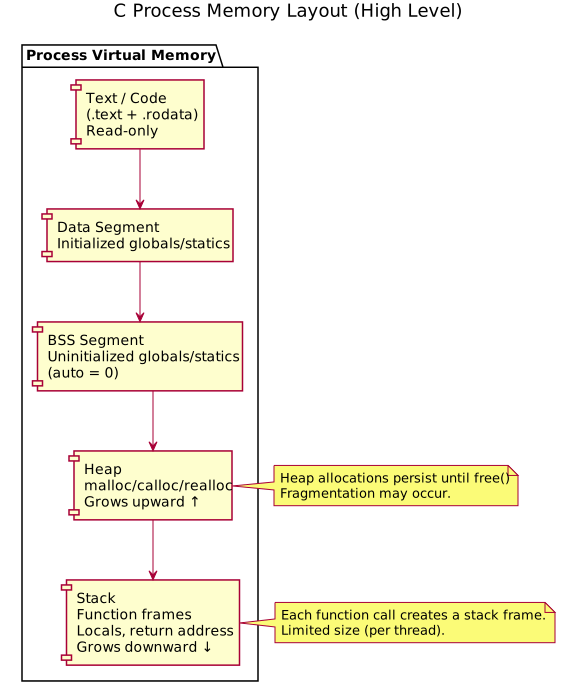
Memory Layout Diagram
 {:class=“diagram-img”}
Shows how a C program is organized in memory into segments like text, data, bss, heap, and stack, including heap/stack growth direction.
1) Text Segment (Code Segment)
- Stores compiled machine instructions
- Usually read-only
- Often split into:
.text: instructions.rodata: read-only constants / string literals
Example:
printf("Hello"); // "Hello" typically in read-only region2) Data Segment
Stores global and static variables.
2.1 Initialized Data
int a = 10;        // global
static int b = 20; // static
These variables appear inside executable with their initial values.
2.2 Uninitialized Data (BSS)
int x;         // global uninitialized
static int y; // static uninitialized- auto initialized to 0
- not stored in binary (only size info)
- reduces executable size
3) Heap Segment
Heap used for dynamic allocation.
Functions:
malloc(size)→ allocates bytes (garbage/uninitialized)calloc(n,size)→ allocates & initializes to 0realloc(ptr,new)→ resize blockfree(ptr)→ release block
Heap key points
- memory persists beyond function scope
- must free manually (else leak)
- allocator stores metadata → some overhead
- fragmentation possible
4) Stack Segment
Used for function execution.
A stack frame usually contains:
- local vars
- args (depending ABI)
- return address
- saved registers / old frame pointer
Why stack is fast?
Because stack allocation is just moving stack pointer.
Stack limitations
- fixed size (per thread)
- deep recursion → stack overflow
- huge local arrays also risky
When is memory allocated? (important)
- Compile time: compiler checks syntax + generates binary
- Load time: OS maps program into memory (text/data/bss)
- Run time: heap/stack change while program runs
Quick experiment
#include <stdio.h>
#include <stdlib.h>

int g1 = 10;      // data
int g2;           // bss
static int s1=7;  // data

int main() {
    int local = 5;        // stack
    int *p = malloc(4);   // heap
    *p = 99;

    printf("&g1=%p\n", (void*)&g1);
    printf("&g2=%p\n", (void*)&g2);
    printf("&s1=%p\n", (void*)&s1);
    printf("&local=%p\n", (void*)&local);
    printf("heap p=%p\n", (void*)p);

    free(p);
}
Observe: stack addr usually higher than heap.
Tools (Linux)
size a.out
nm -S a.out | head
readelf -S a.out | less