2 min read
Pointers in C/C++
Pointers store addresses. In C, they are core to arrays, strings, DMA, and callbacks.
Example:
int a = 5;
int *p = &a;

printf("%d\n", a);    // 5
printf("%p\n", (void*)&a);
printf("%p\n", (void*)p);
printf("%d\n", *p);   // 5
Pointer size
Depends on architecture, not type:
- 32-bit → 4 bytes
- 64-bit → 8 bytes
So int*, char*, double* all same size on same machine.
Why pointer type matters?
Pointer type decides:
- how many bytes to read on dereference
- pointer arithmetic step size
Example:
int a = 1025;
int *p = &a;
char *c = (char*)p;

printf("%d\n", *p); // reads 4 bytes
printf("%d\n", *c); // reads 1 byte
This also relates to endianness.
Dereferencing
*p= value stored at address present in pointer.
int a = 10;
int *p = &a;
printf("%d", *p);
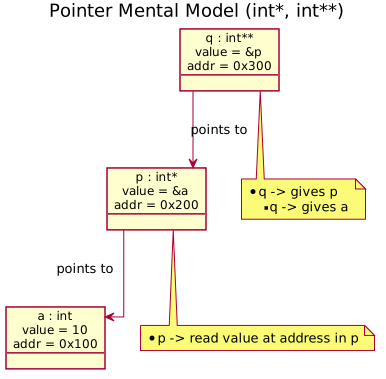
Pointer Diagram
 {:class=“diagram-img”}
Explains the pointer mental model—how an int* points to an integer variable and how an int** (pointer-to-pointer) points to the int* pointer.
Special pointer types
1) NULL pointer
int *ptr = NULL;Always init pointers to avoid wild pointers.
2) void pointer
Generic pointer:
void *vp;- cannot dereference without casting
mallocreturnsvoid*
Example:
int a=10;
void *vp=&a;
printf("%d\n", *(int*)vp);
Wild pointer vs Dangling pointer
Wild:
int *p; // uninitializedDangling:
int *p = malloc(4);
free(p);   // p now dangling
p = NULL;
Pointer arithmetic
If p is int* and p=200:
p+1= 204
Formula:
p + n == p + n*sizeof(*p)Pointer subtraction
Allowed if inside same array:
ptr2 - ptr1returns element distance.
❌ Adding pointers is invalid.
Pointer to pointer
int x = 5;
int *p = &x;
int **q = &p;
int ***r = &q;
Used in:
- modifying pointer from function
- dynamic 2D allocation
- linked list operations
Call by value vs reference
C is call-by-value, but we emulate reference using pointers.
Value
void inc(int a) { a++; }Reference
void inc(int *p) { (*p)++; }Common pointer bugs (must know)
- dereferencing wild pointer
- dereferencing NULL
- use-after-free
- buffer overflow/out-of-bounds
- wrong cast causing misaligned access