1 min read
Stack Frame and Call Stack
The call stack tracks active function calls.
Every function call creates a stack frame and pushes it on stack. When function returns → frame popped.
So stack follows LIFO.
What is inside a stack frame?
Usually includes:
- arguments
- local variables
- return address
- saved registers
- old frame pointer
Actual layout depends on compiler + ABI (x86_64/ARM).
Example call stack
main()
  |
  +-- funcA()
        |
        +-- funcB()
Stack while inside funcB:
Top
+-------------------+  funcB frame
| locals of funcB   |
| return → funcA    |
+-------------------+  funcA frame
| locals of funcA   |
| return → main     |
+-------------------+  main frame
| locals of main    |
+-------------------+
Bottom
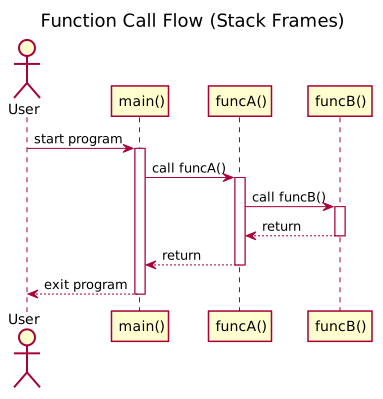
Function Call Flow Diagram
 {:class=“diagram-img”}
Visualizes the function calling sequence and how stack frames are created and destroyed using LIFO behavior during nested function calls.
Stack Overflow
Occurs when stack memory exceeds limit.
Common causes:
- infinite recursion
- very large local arrays
- extremely deep call stack
One stack per thread
Each thread has its own stack.