🚶 Packet Walkthrough — One Connection, End to End
Module 03 gave us the mechanism: a graph of nodes, a feature arc, and a note carried in opaque2. This module turns that mechanism into a story. We’ll follow one packet from the wire to the far side of a VPN tunnel, watch the decision get made, watch the note evolve, and then look at every other path the same pipeline can take — including how the reply gets home.
If Module 03 was “here are the parts,” this is “here’s the machine running.”
Table of Contents
- The Setup
- The Journey, Step by Step
- The Six Possible Paths
- When Things Get Dropped
- The Return Trip
- IPv6: the Mirror World
- How to Watch This Happen
- Key Takeaways
- What’s Next
The Setup {#setup}
Our example: a host on the inside network opens a connection to a service that lives across a site-to-site VPN tunnel. So this packet must be inspected (it’s going somewhere sensitive), NAT’d (the inside address is private), and encrypted (it’s leaving over IPsec). That’s the richest path through the firewall, which makes it the best one to trace.
Concretely, the platform is configured so that:
- The inbound interface is a VLAN sub-interface with the firewall feature arc enabled (
ngfw-decision,snort,ngfw-post-snortonip4-unicast). - An ACL rule matches this flow and carries the steering tag
SNORT_NAT_IPSEC— “inspect it, translate it, encrypt it.” - An IPsec Security Association (SA) for the tunnel has already been negotiated by the control plane (Module 02) and installed in the data plane.
- The VPN-out interface is where encrypted packets leave.
The Journey, Step by Step {#journey}
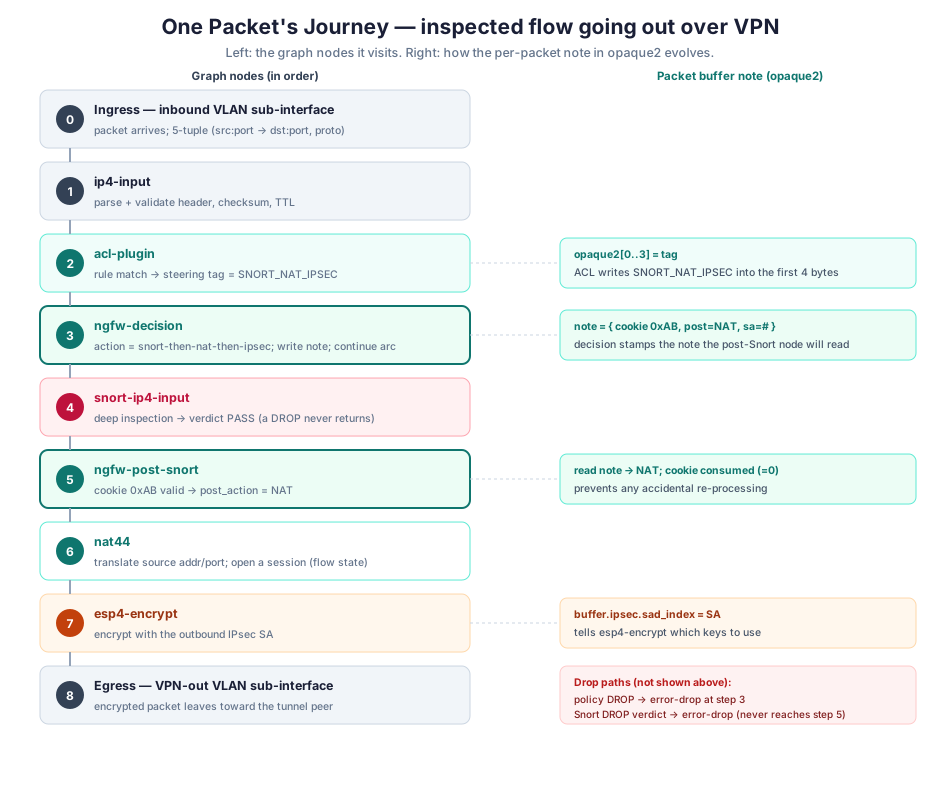 {:class=“diagram-img”}
The left column is the sequence of graph nodes; the right column shows the per-packet note in opaque2 changing as the packet moves.
Step 0 — Ingress. The packet lands on the inbound VLAN sub-interface. DPDK’s poll-mode driver picks it up (no interrupt) and hands it, as part of a batch, into the graph. At this moment it’s just bytes with a 5-tuple: source IP:port → destination IP:port, protocol.
Step 1 — ip4-input. VPP’s standard IPv4 entry node validates the header — checksum, length, TTL — and places the packet onto the ip4-unicast feature arc. From here on, the packet visits whichever arc features are enabled on this interface, in their registered order.
Step 2 — acl-plugin. The ACL feature matches the packet against the rule set. Our rule hits, and its steering tag — SNORT_NAT_IPSEC — is written into the first four bytes of the packet’s opaque2 scratch area. The ACL has now answered “which rule matched and what does it want?” but hasn’t acted.
📝 opaque2 now:
[SNORT_NAT_IPSEC][ - ][ - ][ - ]
Step 3 — ngfw-decision. Registered runs_after the ACL and runs_before Snort, this node reads the tag and translates it into an internal action: snort-then-nat-then-ipsec. Because that action requires inspection, the node does not short-circuit. Instead it:
- writes the note the post-Snort node will need —
{ cookie = 0xAB, post_action = NAT, out_sa_index = <the tunnel SA> }— intoopaque2(after the ACL tag, which stays at offset 0), and - calls
vnet_feature_next()to let the arc continue naturally to Snort.
📝 opaque2 now:
[SNORT_NAT_IPSEC][cookie 0xAB][post=NAT][sa=#]
Step 4 — snort-ip4-input. The packet is handed to the Snort IPS for deep inspection (the how — shared memory and the DAQ — is Module 05). Snort scans the payload against its signatures and renders a verdict. Two outcomes:
- PASS → the packet continues down the arc to the next feature.
- DROP → the packet is sent straight to
error-dropand never comes back to our nodes. (This is correct IPS behavior — a malicious packet is gone.)
Our packet is clean, so: PASS.
Step 5 — ngfw-post-snort. Registered runs_after Snort, this node runs only for survivors. It checks the cookie: is opaque2 carrying our 0xAB marker? Yes — so this is a packet we tagged. It reads post_action = NAT, steers the packet toward the NAT node, and consumes the cookie (sets it to 0) so nothing can accidentally reprocess it.
📝 opaque2 now: cookie cleared — the note has done its job.
Step 6 — nat44. The NAT node rewrites the private source address/port to a public one and creates a session — a flow-table entry keyed by the 5-tuple. That session is what lets the reply find its way back later (stateful NAT, exactly the Gen-2 idea from Module 01).
Step 7 — esp4-encrypt. Because the destination is across the tunnel, the packet is routed into IPsec encryption. The SA index recorded earlier tells this node which keys to use; it wraps the packet in ESP and encrypts the payload.
Step 8 — Egress. The encrypted packet leaves on the VPN-out VLAN sub-interface, headed for the tunnel peer. Journey complete.
The whole trip was: classify → decide → inspect → act → translate → encrypt → forward, with a tiny note ferrying the “what to do after Snort” decision across the three nodes that couldn’t all run at once.
The Six Possible Paths {#six-paths}
Our packet took the deepest path, but the same pipeline produces six different journeys depending on the ACL tag. This is the whole policy surface in one picture:
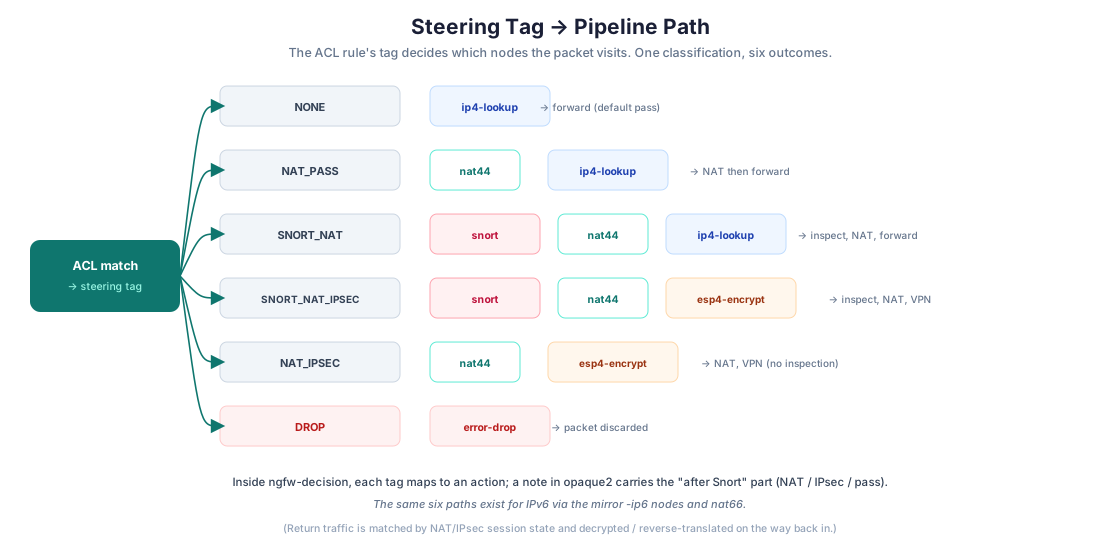 {:class=“diagram-img”}
One ACL classification, six outcomes. The tag decides which nodes the packet visits.
| Steering tag | Path | Meaning |
|---|---|---|
NONE | → ip4-lookup | No special handling — route normally (the default). |
NAT_PASS | → nat44 → ip4-lookup | Translate, then forward (e.g. straight to the internet). |
SNORT_NAT | → snort → nat44 → ip4-lookup | Inspect, translate, forward. |
SNORT_NAT_IPSEC | → snort → nat44 → esp4-encrypt | Our example: inspect, translate, encrypt out the tunnel. |
NAT_IPSEC | → nat44 → esp4-encrypt | Translate and encrypt, without inspection (trusted flow). |
DROP | → error-drop | Discard immediately. |
Notice how much is reused: NAT, Snort, and encryption are the same nodes every time — only the order and inclusion change, driven by the tag. That reuse is exactly what the feature-arc + opaque2 design buys you. Adding a seventh path is mostly a matter of defining a new tag→action mapping, not new machinery.
When Things Get Dropped {#drops}
A firewall is defined as much by what it stops as what it passes. There are two distinct drop points on this pipeline, and it’s worth knowing which is which when you’re debugging:
- Policy drop (
ngfw-decision, step 3). If the matched rule’s tag isDROP, the decision node sends the packet directly toerror-drop. It never reaches Snort. This is a policy decision — “we don’t allow this flow at all.” - Inspection drop (Snort, step 4). If Snort’s verdict is DROP, the Snort machinery routes the packet to
error-dropbefore it can return tongfw-post-snort. This is a threat decision — “this flow is allowed in principle, but this packet is malicious.”
Both increment counters you can read (show node counters), so “was it blocked by policy or by the IPS?” is answerable at a glance — they’re different counters on different nodes. There are also safety drops: e.g. if an IPsec action is selected but the SA index is missing, the post-Snort node drops rather than forward the packet unencrypted — a fail-closed choice.
The Return Trip {#return-trip}
Traffic is a two-way street, and the reply takes a different path — this trips up a lot of newcomers.
When the far-side service answers, its packet arrives encrypted on the VPN-out interface:
- Inbound decrypt. An ESP packet is recognized and sent to IPsec decrypt, using the inbound SA. Out comes the original reply packet.
- Reverse NAT. The NAT node looks up the session created on the way out (step 6) and translates the public destination back to the original private inside address. Because the session already exists, this is a fast table hit — no policy re-evaluation needed.
- Forward inside. A route lookup sends the reply to the inside host.
The key insight: the outbound path sets up state (a NAT session, the SAs), and the inbound path rides that state. This is stateful firewalling in action — the reply is allowed because the request created the context for it, not because a rule explicitly permits it. Break the outbound state and the return traffic has nowhere to land.
IPv6: the Mirror World {#ipv6}
Everything above has an IPv6 twin. The platform registers mirror nodes — ngfw-decision-ip6, ngfw-post-snort-feature-ip6 — on the ip6-unicast arc, and uses nat66 and esp6-encrypt. The logic is identical; only the address structures and a few node names change. When you read the code, expect to see IPv4 and IPv6 handled as parallel paths rather than one unified path — a common and pragmatic choice in packet engines, because the header formats differ enough that merging them would cost more than it saves.
How to Watch This Happen {#watch}
You don’t have to take this walkthrough on faith — VPP will replay it for you. To trace our exact scenario live:
vpp# trace add dpdk-input 100          # capture the next 100 packets from the NIC
   ... send the connection ...
vpp# show trace                        # read each packet's node-by-node path
A single traced packet prints the nodes it visited and, at each custom node, the decision it recorded — the matched rule, the action, the ACL tag, the chosen next node. To see aggregate behavior instead of individual packets:
vpp# show node counters                # per-node: passed / dropped / to-snort / to-ipsec ...
vpp# show runtime                       # per-node clocks-per-packet — find the hot nodes
vpp# show nat44 sessions                # the flow state that lets replies home
When a flow misbehaves, this is the loop: trace add, reproduce, show trace, and read which node made which decision. The pipeline is glass-boxed by design.
Key Takeaways {#key-takeaways}
- The richest path — inspect → NAT → encrypt — visits ACL, decision, Snort, post-Snort, NAT, and ESP-encrypt nodes in order, coordinated by the
opaque2note. - The ACL tag chosen at classification determines which of six paths the packet takes; the nodes themselves are reused across all of them.
- There are two drop points — policy (at the decision node) and threat (at Snort) — plus fail-closed safety drops; they’re distinct counters, so you can tell them apart.
- The outbound path builds state (NAT session + SAs); the return path rides it (decrypt + reverse-NAT). That’s stateful firewalling made concrete.
- IPv6 is a parallel mirror — same logic,
-ip6nodes andnat66. - The entire journey is observable live with
trace add/show trace/show node counters— debug by watching, not guessing.
What’s Next {#whats-next}
We’ve treated Snort as a black box that returns a verdict. The next module opens it: how VPP hands packets to a separate Snort process over shared memory and the DAQ, and how the verdict travels back — the most intricate inter-process channel in the whole platform.