🔐 IPsec / VPN — IKE Control Plane meets VPP Data Plane
Module 05 covered inspection; this one covers the other big external engine: encrypted VPN tunnels. It’s the clearest example in the whole platform of the control-plane / data-plane split from Module 01 — and once you see how the two halves connect, the design of the rest of the box clicks into place.
The guiding question:
How do you do IPsec at line rate when the key negotiation is a slow, stateful cryptographic conversation — and the encryption has to happen on every single packet?
The answer: split the job. A dedicated IKE daemon (StrongSwan’s charon) does the negotiation; VPP does the encryption; and a bridge plugin carries the negotiated keys from one to the other.
Table of Contents
- IPsec in 90 Seconds
- The Two-Part Problem
- StrongSwan & the IKE Daemon
- The Bridge: Programming SAs into VPP
- VICI: charon’s Automation API
- Bringing a Tunnel Up
- Driving IPsec from the VPP Console
- The Data Plane Side
- Rekeying
- Key Takeaways
- What’s Next
IPsec in 90 Seconds {#ipsec-90s}
IPsec is the standard suite for encrypting IP traffic between two endpoints — a VPN tunnel. Four terms cover almost everything you’ll meet in the code:
| Term | Meaning |
|---|---|
| ESP | Encapsulating Security Payload — the protocol that actually encrypts and authenticates each packet. |
| SA (Security Association) | The agreed keys + parameters for one direction of a tunnel. A working tunnel has a pair (in + out). Each SA has an SPI (a number in the packet identifying which SA to use). |
| IKE | Internet Key Exchange — the protocol two peers use to authenticate each other and negotiate the SAs. Modern version: IKEv2. |
| Traffic selectors | Which source/destination ranges are allowed into the tunnel. |
The essential asymmetry: IKE runs occasionally (bring a tunnel up, rekey it every few minutes), while ESP runs on every packet. That asymmetry is why the two live in different planes.
The Two-Part Problem {#two-part}
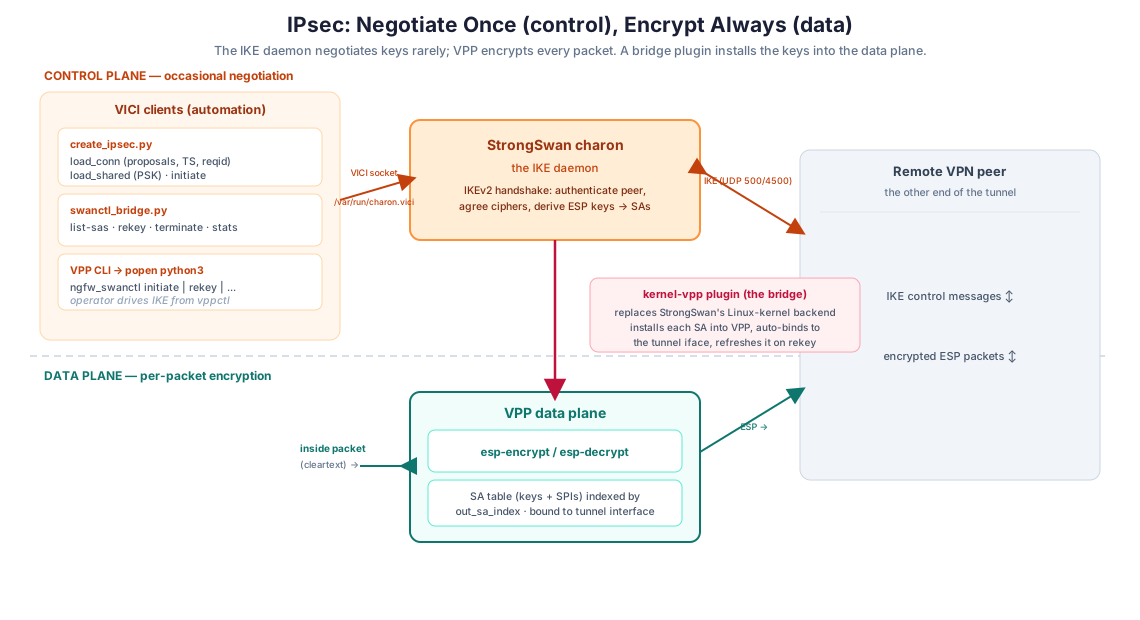
Encrypting a packet is a data-plane job — it must happen at line rate for every packet, so it belongs in VPP alongside forwarding and NAT. But negotiating the keys is a completely different animal: a multi-round-trip, stateful, cryptographic handshake with the remote peer, involving Diffie-Hellman, authentication, retries, and timers. You would never want that logic on the packet hot path.
So the platform splits IPsec cleanly in two:
 {:class=“diagram-img”}
The IKE daemon (control plane) negotiates keys rarely; VPP (data plane) encrypts every packet. The kernel-vpp bridge plugin installs the negotiated keys into VPP.
- Control plane: StrongSwan
charonspeaks IKEv2 to the remote peer and produces SAs. - Bridge: a kernel-vpp plugin takes each negotiated SA and installs it into VPP.
- Data plane: VPP’s
esp-encrypt/esp-decryptnodes do the actual crypto, using those SAs, at line rate.
Everything below is just the detail of those three boxes and the arrows between them.
StrongSwan & the IKE Daemon {#strongswan}
StrongSwan is a mature open-source IPsec implementation; its IKE daemon is called charon. Reusing it is the same “don’t reinvent a hard, security-critical thing” choice made for Snort. charon handles:
- the IKEv2 handshake with the peer (key exchange + mutual authentication, here via a pre-shared key),
- deriving the ESP keys and establishing the child SAs,
- lifetimes and rekeying — SAs expire on purpose, and charon renegotiates before they do,
- retries, dead-peer detection, and all the messy real-world edge cases.
In a stock setup, charon would install the SAs it negotiates into the Linux kernel’s IPsec stack. But we don’t want the kernel doing encryption — we want VPP doing it. That’s what the bridge changes.
The Bridge: Programming SAs into VPP {#bridge}
StrongSwan has a pluggable “kernel” backend — the component that receives negotiated SAs and installs them somewhere. Normally that “somewhere” is the Linux kernel. This platform swaps in a custom kernel-vpp plugin so that “somewhere” becomes VPP.
Concretely, when charon finishes a negotiation, the kernel-vpp plugin:
- Installs the SA into VPP — adds the keys/SPIs to VPP’s SA table so
esp-encrypt/esp-decryptcan use them. - Auto-binds the SA to the VPP tunnel interface — so you don’t have to run a manual “protect this tunnel” command in VPP; the plugin wires the SA to the right interface automatically (linked by a
reqidshared between the StrongSwan child config and the VPP tunnel). - Refreshes on rekey — when charon rekeys (new keys, new SA indices), the plugin updates the binding so the tunnel keeps working seamlessly. This is the subtle part: SA indices change on every rekey, and the plugin keeps the interface↔SA binding correct across each refresh.
It supports both VPP tunnel styles — the older ipip tunnels and the preferred ipsec interface tunnels — configurable so both ends agree. The net effect: charon thinks it’s programming “the kernel,” but the kernel is really VPP. That’s the whole trick, and it’s why VPP can encrypt at line rate while StrongSwan handles all the IKE complexity.
VICI: charon’s Automation API {#vici}
How does anything tell charon to load a tunnel or rekey one? Through VICI — charon’s Versatile IKE Configuration Interface, a local Unix-domain socket (/var/run/charon.vici) that exposes charon’s operations to programs. Anything that speaks VICI can:
load_conn— define an IKE connection + child SA (proposals, traffic selectors, reqid, lifetimes),load_shared— install a pre-shared key,initiate/terminate— bring a specific tunnel up or down,rekey— force a renegotiation,list_sas,get-counters,stats— read live tunnel state.
This platform drives VICI from Python using the vici library. Two scripts do the work:
create_ipsec.py— the setup script. It opens the VICI socket, callsload_connwith the connection definition (IKE version, proposals, ESP proposals, traffic selectors auto-derived from the address family,reqid, rekey/lifetime),load_sharedfor the PSK, theninitiateto bring the child SA up. There’s a matchingdeletethat terminates and unloads.swanctl_bridge.py— the runtime script. It wraps day-to-day operations:list-sas(formatted tunnel status),rekey,terminate,initiate,stats,counters, andload-all. Rekey/initiate/terminate are fired in the background (timeout -1) so the caller returns immediately rather than blocking on the negotiation.
Using VICI (rather than shelling out to the swanctl command for everything) means the platform gets structured request/response data back — which is what makes the nicely formatted status output possible.
Bringing a Tunnel Up {#bringup}
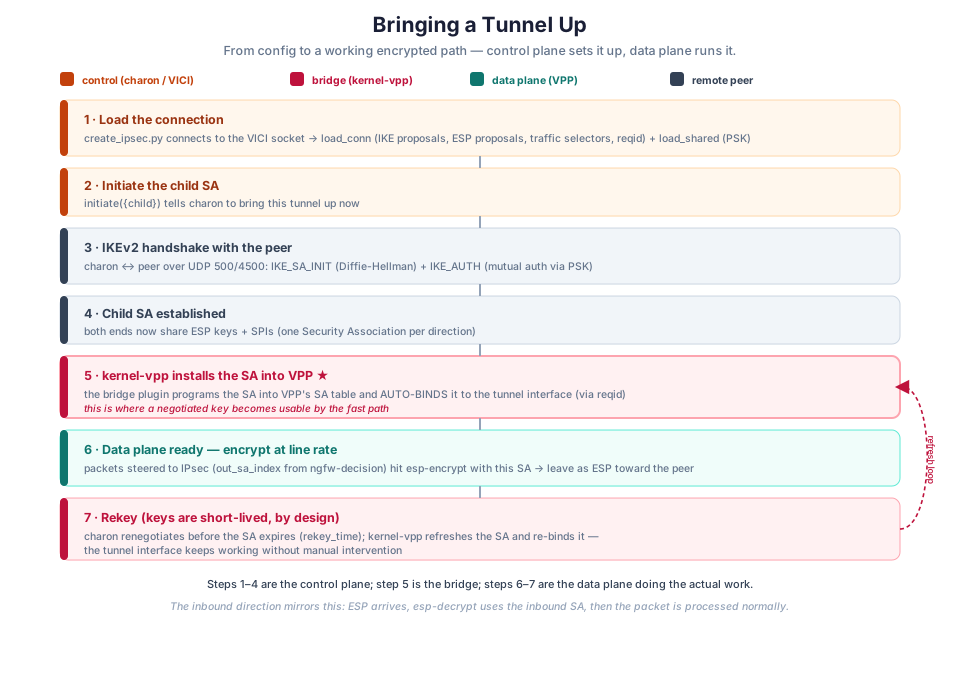
Putting the pieces in motion, here’s the full lifecycle from config to encrypted packets:
 {:class=“diagram-img”}
Steps 1–4 are the control plane, step 5 is the bridge, steps 6–7 are the data plane doing the actual work.
- Load the connection.
create_ipsec.pyconnects to VICI and callsload_conn(IKE + ESP proposals, traffic selectors,reqid) andload_shared(the PSK). - Initiate the child SA.
initiate({child})tells charon to bring this tunnel up now. - IKEv2 handshake. charon talks to the peer over UDP 500/4500:
IKE_SA_INIT(Diffie-Hellman) thenIKE_AUTH(mutual authentication with the PSK). - Child SA established. Both ends now hold matching ESP keys and SPIs — one SA per direction.
- kernel-vpp installs the SA into VPP ★ and auto-binds it to the tunnel interface (via
reqid). This is the moment a negotiated key becomes usable by the fast path. - Data plane ready. Packets steered to IPsec (remember
out_sa_indexfrom the decision node) hitesp-encryptwith this SA and leave as ESP toward the peer. - Rekey happens automatically before the SA expires (next section).
The inbound direction mirrors this: an ESP packet arrives, esp-decrypt uses the inbound SA to recover the original packet, and it’s then processed normally (reverse-NAT, forward) — exactly the return trip from Module 04.
Driving IPsec from the VPP Console {#vpp-console}
Here’s a neat integration detail that ties the planes together for the operator. An admin usually lives on the VPP console (vppctl) — they shouldn’t need to jump to a different tool to check tunnels. So the ngfw_decision plugin adds ngfw_swanctl ... CLI commands to VPP:
vpp# ngfw_swanctl show sas          # list active IKE + child SAs
vpp# ngfw_swanctl initiate <child>  # bring a tunnel up
vpp# ngfw_swanctl rekey child <name>
vpp# ngfw_swanctl stats             # charon daemon stats
Under the hood, each of these simply popen()s python3 swanctl_bridge.py <verb> and streams the script’s output back to the VPP console. So the flow is:
operator → VPP CLI → popen python bridge → VICI socket → charon.
It’s a deliberately thin shim — VPP doesn’t reimplement IKE management; it just shells out to the Python that already knows how to talk to charon. This is a recurring theme worth internalizing: when you need a capability that already exists in another process, bridge to it rather than rebuild it. The whole platform is bridges.
The Data Plane Side {#data-plane-side}
From the data plane’s point of view, all this control-plane machinery boils down to one thing: an SA sitting in VPP’s SA table, ready to use. When the decision node chose an IPsec action (Modules 03–04), it recorded an out_sa_index — an index into that table. At esp-encrypt, VPP looks up that SA, encrypts the packet with its keys, stamps the SPI, and sends it out the tunnel interface.
That’s the beauty of the split: the hot path never touches IKE, PSKs, or negotiation. It does a table lookup and a crypto operation — fast, deterministic, and blissfully unaware of the multi-round-trip handshake that produced the keys. All the complexity was paid once, in the control plane, and cached as an SA the data plane can use millions of times.
Rekeying {#rekeying}
IPsec SAs are short-lived on purpose — limiting a key’s lifetime limits the damage if it’s ever compromised, and caps how much data is encrypted under one key. So charon rekeys: before an SA expires (its rekey_time), it negotiates a fresh one.
Rekeying is exactly where a naive VPP integration would break, because the new SA has a new index, and the tunnel interface was bound to the old one. The kernel-vpp plugin handles this: on each rekey it installs the new SA and re-binds the tunnel interface to it, so traffic flips to the new keys with no manual step and no dropped tunnel. Getting this refresh-on-rekey binding right is one of the genuinely fiddly parts of the platform — and a good example of why the “boring” lifecycle details matter as much as the initial happy path.
Key Takeaways {#key-takeaways}
- IPsec splits naturally: IKE negotiation is occasional (control plane); ESP encryption is per-packet (data plane). That asymmetry drives the whole design.
- StrongSwan
charondoes the IKEv2 handshake and produces SAs (keys + SPIs, one per direction); it’s reused rather than reimplemented. - A kernel-vpp bridge plugin replaces StrongSwan’s Linux-kernel backend so negotiated SAs are installed into VPP and auto-bound to the tunnel interface.
- VICI is charon’s automation socket;
create_ipsec.pysets tunnels up (load_conn+load_shared+initiate) andswanctl_bridge.pyruns day-to-day ops. - The VPP CLI exposes
ngfw_swanctlcommands that justpopenthe Python bridge — the operator drives IKE without leaving the console. - The data plane only ever sees an SA in a table referenced by
out_sa_index;esp-encryptdoes a lookup + crypto and forgets the rest. - Rekeying refreshes SAs periodically; the bridge re-binds the tunnel interface to each new SA so the tunnel survives seamlessly.
What’s Next {#whats-next}
We’ve now covered both external engines (IPS and IPsec) and the data plane that ties them together. The last mechanism to open is the management plane: how the Java bridge reads VPP’s counters and stats (over JNI, the stats segment, and the binary API) and serves them northbound — turning all the per-packet activity we’ve traced into dashboards and alarms.